


The World's Best Freshwater Game Fish. Book your guided trip on the Rogue. Oregon's unmatched river for consistent, high-yield Steelhead fly fishing.
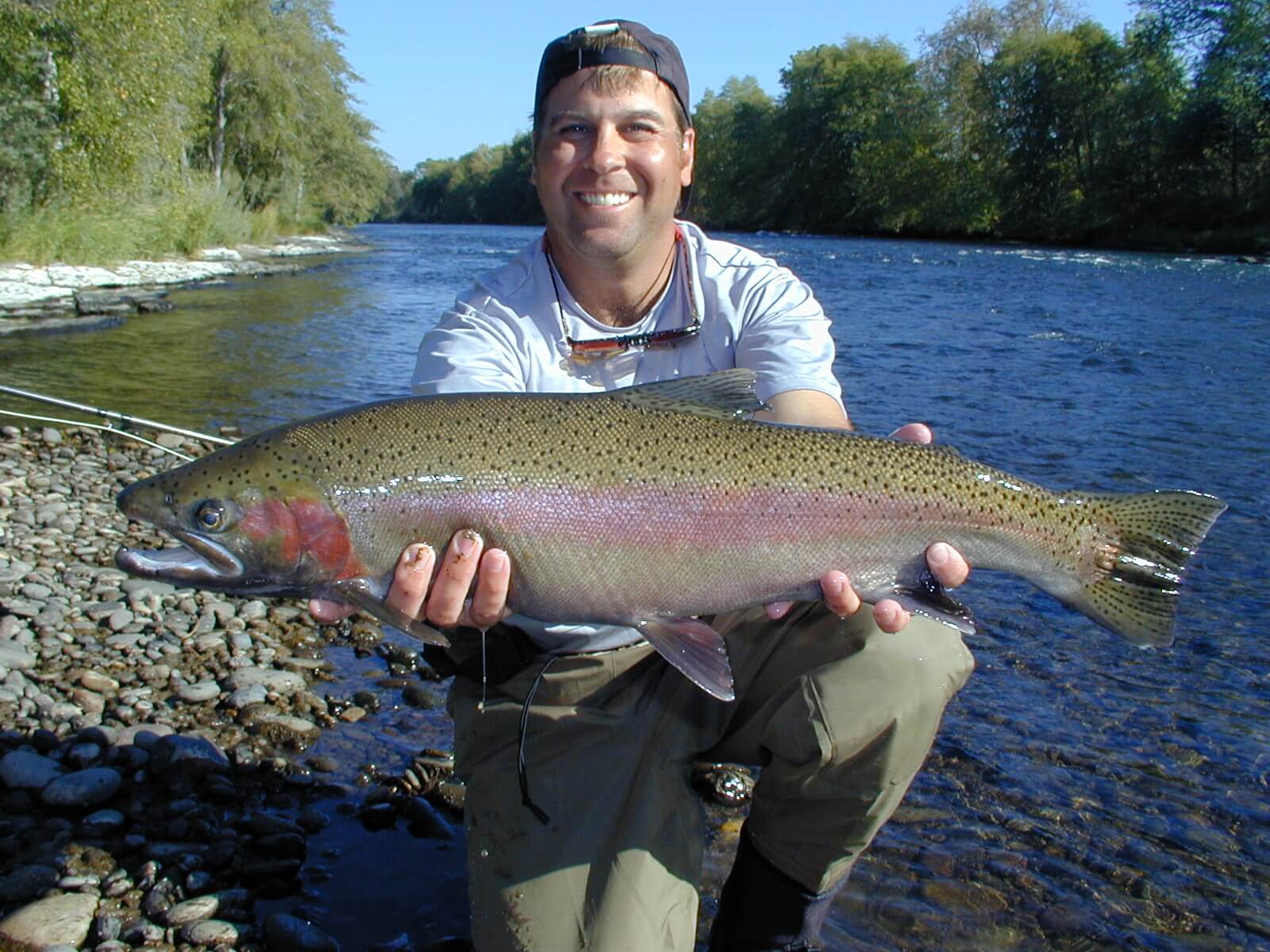
Southern Oregon’s Rogue River stands alone in the Pacific Northwest when it comes to the possibility of catching a steelhead on a fly rod. This picturesque stream steeped in presents the best likelihood for beginner and veteran alike to hook a crazy sea-going rainbow (a.k.a. Steelhead) even when compared to the imposing likes of fabled steelhead waters as the Deschutes and North Umpqua. Rogue River steelhead are “grabby”, considering these are fish that do not need to eat during their spawning migration.
This fishery is so exceptional it is here that our Rogue River steelhead fishing guides choose to spend their personal fishing time late summer and fall, even though the steelhead of the famous Umpqua River to the north and the Klamath River to the south are only a couple of hours away.
There are two components to the summer/fall run of Rogue River steelhead: the familiar one-salt (one year at sea) and two-salt (two years at sea) fish, and, secondly, the precocious, aggressive “half-pounder” steelhead for which the river is most famous.
The half-pounders are a peculiar race that spend only several months in the saltwater bay at Gold Beach before making a “U” turn, returning to freshwater as smaller counterparts of the one- and two-salt full-size steelhead. Add resident rainbow trout, sea-run cutthroat, chinook salmon, and silver salmon to the seasonal river mix, and an angler has a large “buffet” of exciting fishing possibilities. Though we are targeting steelhead, catching a chinook salmon is a daily possibility in August and September.
With almost 150 river miles from Lost Creek Dam to the Rogue River’s mouth, knowing where to fish at any given time of year is imperative. Though there are steelhead in the Rogue virtually every month of the year, August through November present the best water conditions combined with fishable numbers of willing Rogue River steelhead.
As for steelhead fly fishing methods, dry flies, wet flies, and nymphs can all be effective. If a skilled angler takes into account the water temperature, time of day and the right piece of water, it’s a real possibility to catch Rogue River steelhead using all three methods in a single summer or early fall day. Nymphing proves effective year-around, even when the water is too cold to interest fish in a skated dry or standard wet fly presentation. (A good Rogue River steelhead fly fishing guide MUST know how to fish nymphs, and be well-versed in effective Rogue River steelhead flies.)
Because at any given time an individual steelhead may not be in a biting mood, a good strategy is to thoroughly cover a given piece of water then move on. However, if you know the run to be a good one, with a high probability that it holds numerous steelhead, it may be worth your time to switch flies or presentations and cover the water a second time before moving on.
One of the most important decisions your competent Rogue River steelhead guide will make is knowing when to pull anchor and float to the next likely fishing hole. When to linger — changing flies or tactics — and when to run. Knowing “when to hold ’em, and when to fold ’em.”
If I might indulge in a gambling analogy . . . Steelhead fly fishing is like repeatedly pulling the handle on a slot machine: the more good casts you make in likely waters, the greater the likelihood you will “hit the jackpot”. To increase your odds of hooking a steelhead cover the water quickly and completely, then get to the next downstream casino. Keep pulling that slot machine handle. Be warned! Once you experience the beautiful upper Rogue River and its magnificent steelhead, you WILL return here to again pursue The World’s Most Magnificent Freshwater Game Fish. Note: Most anglers will fish 2 days; some 3 days. Though certainly not a requirement, two days optimizes chances for landing steelhead. Beginners are always welcome, of course. With no learned bad habits, it is not unusual for a beginner to out-fish a veteran angler who has unproductive fishing habits learned and practiced for years. As with all my guided fishing trips, no wading is required. All fishing is done from the boat in order to effectively cover and comfortably access miles of fishy water in our eight hours on the river.
Most anglers motel-it in Shady Cove, 20 miles north of Medford. The Rogue River flows through town. There are 3 motels and two RV parks. An internet search will show your options.
Click on the image to see more photos


McKenzie Mastery: A year-round clear-water fishery heaven. Fish the precise hatches with an expert who knows every seasonal shift.
Winter Bounty. Nestucca's reliable runs hold generous numbers of hatchery and native steelhead. Fish with the expert who maximizes coverage during the cold season
Siletz Checkmate: The ultimate freshwater accomplishment. Fish Winter Steelhead with a Master Guide who plays the cold-water game of chess to beat the odds.